Foreword
Yannik fixed the spoofer.
That has to be the first sentence on this page, because everything that follows exists only because he was on the inside of it. He was paid to work on the tool that faked the player count on this server, and he did it while he was in debt. That is a reason. It is not an excuse, and this page does not present it as one.
He has already given the same account to the developers of The Isle in writing, along with an offer to hand over the source he was sent, the screenshots, and anything else they asked for. None of what follows was dragged out of anyone. It was volunteered by the person who helped build the thing.
The reason it is also being published here is simple. A report to a studio sits in an inbox. The people who were actually affected never hear about it, and the server keeps running. Every player who picked that server because it looked busy made that choice based on a number somebody typed in. Every admin who spent unpaid evenings moderating it was working for someone who is described in the second half of this page. Those people are entitled to know.
There are two subjects here. The first is the player count, which is a lie told to strangers to bring them in. The second is how the people who ran the server were treated once they were in. They are connected, and the connection is that both were considered acceptable by the same person for as long as they worked.
A note on how this page handles evidence. Where something is shown in a screenshot, the screenshot is here and you can read it yourself. Where a claim rests on the accounts of people who worked there rather than on a document, the page says so in the sentence that makes the claim. There is no third category. Nothing here is presented as established because it sounds plausible.
Key Individuals and Roles
| Name | Role |
|---|---|
| WRIGHTY | Server owner, commissioned the spoofer |
| Yannik | Ex-Developer |
| ZaayaN | Former content creator for the server and Patreon supporter |
| Anonymous supporter | Paying Patreon member, lost access after cancelling the renewal |
| Anonymous staff member A | Former senior staff, subject of Part II, kept anonymous at their own request |
| Anonymous staff member B | Former staff, kept anonymous at their own request |
| Anonymous staff member C | Former staff, kept anonymous at their own request |
| Anonymous staff member D | Former staff, kept anonymous at their own request |
| Anonymous staff member E | Former staff, kept anonymous at their own request |
| Anonymous staff member F | Former staff, kept anonymous at their own request |
Six people who worked on that server contributed to this page, along with a paying supporter, and none of them are named on it. That is their decision, taken because speaking publicly about a server owner who still runs communities carries a cost they should not have to pay. Where their accounts are used, the text says that it is an account rather than a document.
Part I: Analysis of Alleged Player Count Manipulation
The Isle publishes its server list through Epic Online Services. When a server shows up in that list, the player count printed next to its name is not measured by anyone. It is a number the server reports about itself, and the browser prints what it is given. Nothing checks it against the players actually connected. A server that reports 80 players is displayed with 80 players whether 80 people are on it or nobody is.
That gap is the entire attack, and it works because of what players do with the list. The Isle is a game where an empty server is not merely quiet, it is unplayable. There is nobody to group with, nobody to run from, nothing happening. So players sort by population and join from the top, which is exactly the behaviour the list was designed to encourage. The moment a server can write its own number, that behaviour can be farmed.
The effect compounds. A server that shows a high count gets real joins. Those real joins make the count genuinely higher. The higher count pulls in more real players, and after a few hours nobody can tell which part of the population was seeded and which arrived on its own. The lie only has to hold at the start. After that the crowd it attracted keeps it standing.
This is why inflating the number is not a cosmetic lie or a bit of harmless marketing. It is the mechanism by which the server was populated. Every genuine player who scrolled that list, saw a busy server, and clicked join was recruited by a figure that had been chosen rather than counted. They then spent their evenings there, some of them spent money there, and some of them stayed for months. All of it started with a number that was not real.
It also takes directly from the servers that do not do this. The list is finite and attention is finite. A server sitting honestly at 40 players is pushed down the page by one claiming 160, and the players who would have found the honest server never scroll far enough to see it. Every player gained this way was taken from someone who was not cheating.
The tool
The spoofer works by presenting a fake version of EOS to the game.
The description stops there, and that is deliberate. Explaining how it is put together would hand a working method to everyone who reads this page, including people running servers who have not thought of it yet. The purpose here is to end this, not to publish a manual. Anyone with a legitimate reason to see the technical detail, meaning the developers of the game, has already been offered all of it.
WRIGHTY did not build it. It was made for him by someone else, and when it did not do what he had been told it would do, he went looking for a developer who could finish the job.
How it started
On 26 May 2026 he brought it to Yannik.
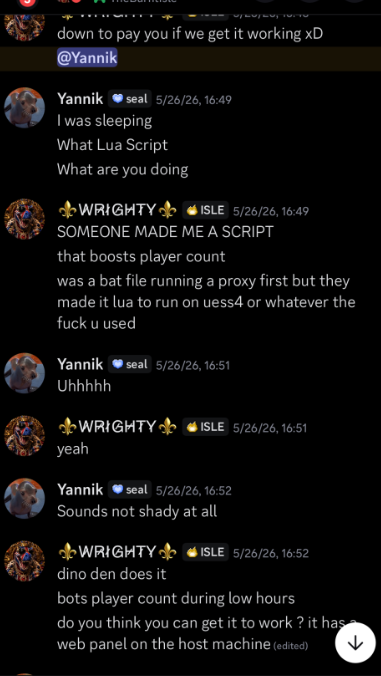
He describes the thing himself, without being asked to, and the description is not ambiguous. A script that boosts player count. Originally a batch file running a proxy, later rewritten in Lua so it would run against the setup he had. A web panel on the host machine to drive it. He is not describing something he half understands or picked up by accident. He is describing a product he has been sold, and he is asking whether it can be made to work.
He also supplies his own justification in the same breath, before anyone challenges him on it. He names another server and says that server bots its player count during low hours. That is worth sitting with. His first instinct when introducing the subject is not to hide it but to normalise it, because in his account of the situation this is simply a thing servers do and he is behind on it.
Yannik's response in that same exchange was that it sounded shady. He is on record recognising exactly what he was being asked to help with. He worked on it anyway. That is the part of this page he does not get to walk away from, and it is why his name is in the cast list above rather than kept out of it.
What it was for
Minutes later he explains the purpose in plain terms: the server had lost players after a rough patch, and he wanted to add extra numbers during the quiet hours to pull in EU players.
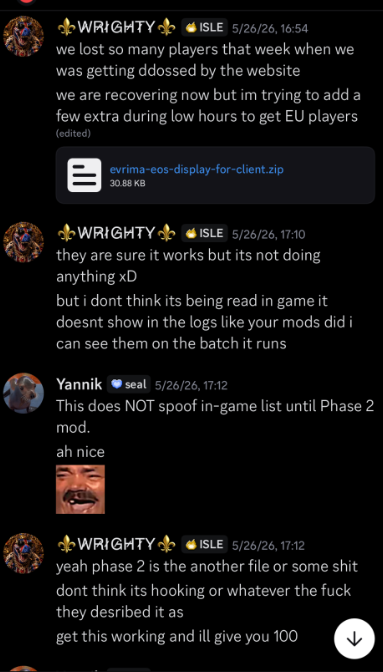
That sentence contains the whole intent. Not a test, not curiosity, not a display bug he wanted corrected. A deliberate plan to make the server appear populated at the exact hours when it was not, aimed at a specific audience he wanted to capture, timed for when real players browsing the list would be most likely to pick whatever looked alive.
The file itself is visible in that exchange, named for the client-side EOS display. When Yannik told him that the version he had would not touch the in-game list without a second component, he did not reconsider. He asked what it would take and offered money to get it finished. The obstacle was technical, and technical obstacles get budget.
So the sequence is: a tool acquired from a third party, a diagnosis that it was incomplete, a payment offered to complete it, and a stated goal of making an empty server look busy so that real people would join it. Each of those steps is documented above in his own words.
Six weeks later
On 5 July 2026 it was still running, and he was still setting the number by hand.
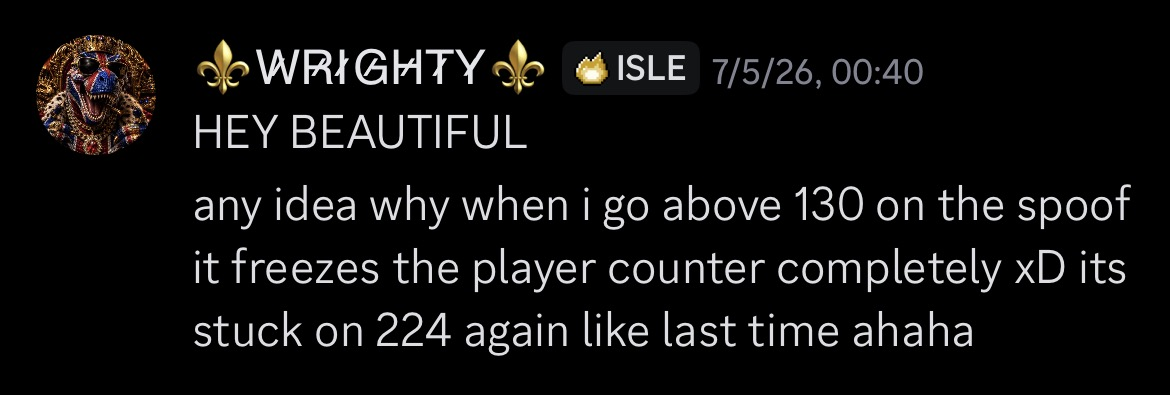
Read what he is actually asking. Not whether it works. Not whether he should be doing it. He wants to know why the counter freezes when he pushes the fake figure above 130, and he mentions in passing that it got stuck at 224 the same way once before.
Three things follow from that message. It was still in use six weeks after the first conversation, so this was not a one-off experiment that fizzled out. He was operating it personally and adjusting the value himself, so there is no version of this where a tool was installed by someone else and left running unattended. And he had done it enough times to have a favourite failure mode, which is what "again like last time" means.
The tone is worth noting as well. It is cheerful. There is no trace of someone who thinks he is doing something he would have to answer for.
The numbers
On one occasion the server had roughly 60 real players connected while the browser advertised around 160. Sometimes the gap was wider, sometimes narrower. The 5 July message puts a displayed figure of 224 on record and shows him trying to push past 130 on the spoof itself.
Put in the simplest terms: at that moment, about two out of every three players advertised to the public did not exist. Someone scrolling the server list saw one of the busiest servers available. What was actually waiting for them was a third of that.
Whether the server is still doing this today is not something this page can confirm, and it is not going to pretend otherwise. The spoof runs server-side. From the outside there is no way to distinguish a real count from a reported one, which is the reason the technique works at all. That uncertainty is stated here rather than quietly dropped, because a page that overstates the parts it cannot prove has no business asking to be believed on the parts it can.
The panic
It came to a head when Dondi said he would go after servers running this kind of thing.
WRIGHTY panicked. Not "disagreed", not "argued that it was standard practice", not any of the defences he had offered when he was introducing the subject. The moment consequences became plausible, the confidence evaporated.
That reaction is its own piece of evidence. Someone who genuinely believed this was normal, harmless, and something everyone does had no reason to be frightened by an announcement aimed at people doing exactly that. The fear only makes sense if he understood the whole time what the tool was and what would happen if the wrong people found out.
Part II: Staff Management and Internal Conduct
The people in this section were not random players who annoyed him in chat. They were his staff. They ran the server for him, which is unpaid work: handling complaints, moderating disputes, absorbing abuse from players, and giving up evenings to keep a community functioning for someone else's benefit.
How an owner speaks to the people doing that job, in private, when he thinks it stays between them, is the most honest measurement of him available. Public conduct is managed. This is not.
Several of them appear in what follows. Most of the exchanges are with the senior staff member who held the team together day to day, because they were the person he dealt with most and the person who kept the receipts. Others appear through what he says about them: two admins who resigned, a third whose access he removed for helping them leave, and the players and volunteers he describes along the way.
Their names and profile pictures are blacked out in every screenshot below, and none of them are named on this page. That is at their request and it is not a small detail. People who were on the receiving end of this have to weigh being dragged through it again in public against the risk of it continuing, and that choice belongs to them and nobody else. Nothing in the messages has been altered. Only the identifying parts are covered.
A note on the name that is visible. He appears in these screenshots as Munchkin rather than WRIGHTY. That is not a second account or a rebrand. Discord lets you set a private nickname for a contact that only you can see, and Munchkin is the nickname one of these staff members had given him. Those screenshots come from their phone, so they show their name for him.
It is worth pausing on that, because it dates the relationship. You do not put a pet name on someone in your contacts unless, at some point, you were on good terms with them. They were. What follows is how that was repaid.
The insults
This is how he refers to his own community members in front of the staff who moderate for him.
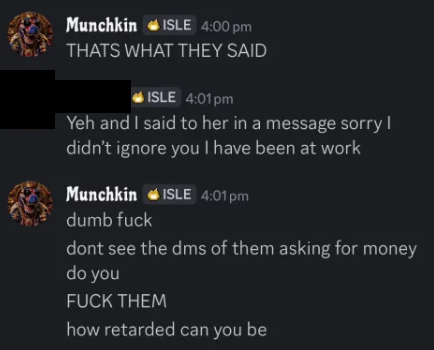
The context matters. The staff member is telling him that they had messaged someone to apologise, explaining they had not been ignoring that person, they had been at work. That is an admin doing the job properly: a player felt overlooked, they followed up, they were honest about the reason.
His response calls them a dumb fuck, tells them the people involved can get fucked, and asks how retarded they can be. All of it directed at someone whose offence was handling a complaint the way it should be handled, in their own time, around a job they have to work.
Note also what he says about the players themselves. These are members of the community his server depends on, and they are discussed as an irritation to be dismissed. The people paying him and the person moderating for him are treated with the same contempt in the same message.
When they pushed back
On 23 July 2026 the staff member raised a moderation problem. Players were ignoring the rules, the server population had grown, and they had brought it up somewhere other staff could weigh in because the rest of the team saw it the same way.
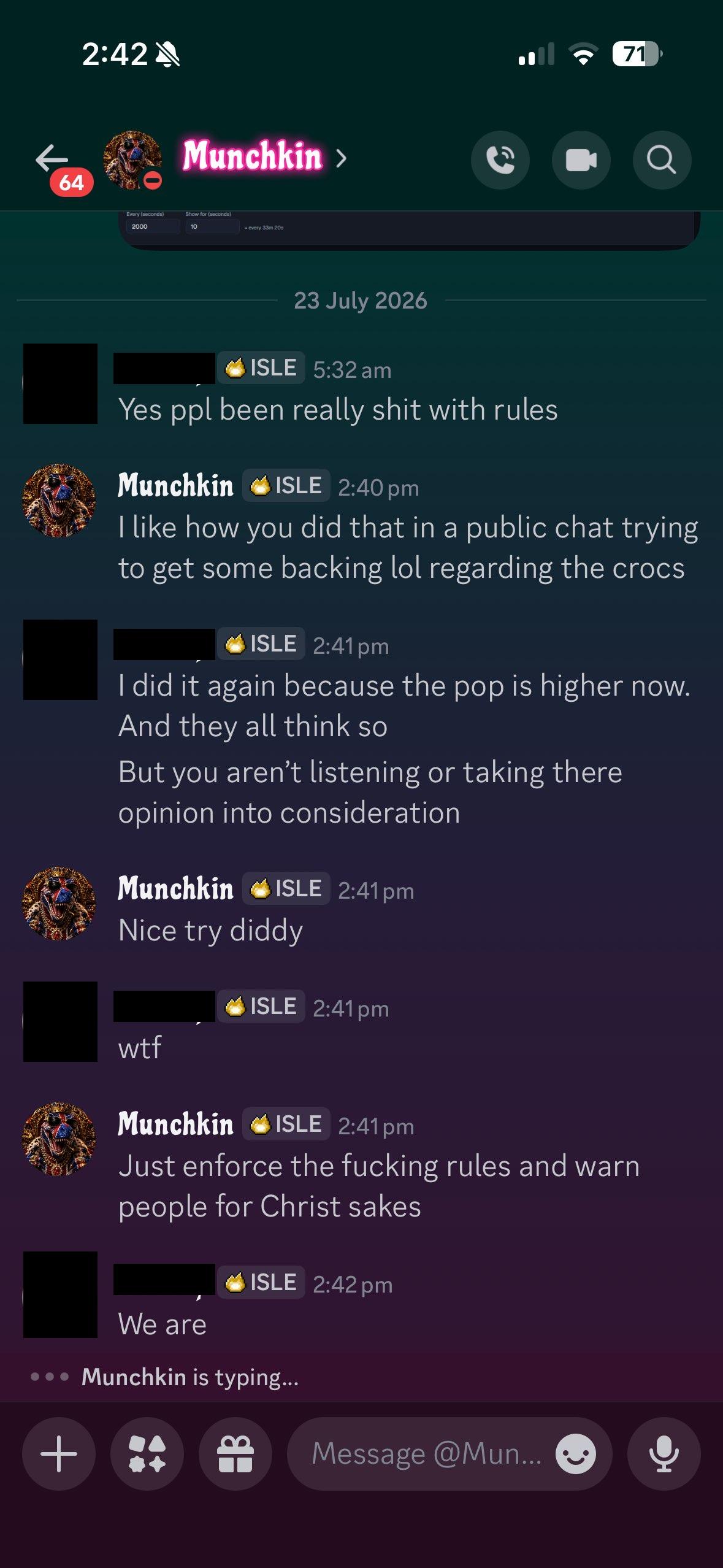
Every part of that is ordinary staff work. Notice a pattern, check it against colleagues, raise it with the owner. They even explain the reasoning without being asked: they brought it up again because the population is higher now and the problem scales with it.
He engages with none of it. He does not address the rule problem, the growth, or the fact that his team agreed. He accuses them of going public to gather support against him, as though staff reaching consensus is a manoeuvre rather than the job. Then he calls them "diddy". When they ask what that is supposed to mean, he skips past the question entirely and tells them to enforce the rules, which is the exact thing they had just finished telling him the team was already doing.
The nickname is not banter between friends. It refers to a man convicted in a sexual abuse case, and it was aimed at a member of his own staff whose offence was disagreeing with him about server rules. There is no reading of that word in that position that is not meant to degrade the person it is aimed at, and he reached for it within seconds of being contradicted.
The pattern across both screenshots is the same. They raise something legitimate. He does not answer it. He attacks them instead, and the actual issue is never resolved.
The pings
When they stopped replying, this is what he sent.
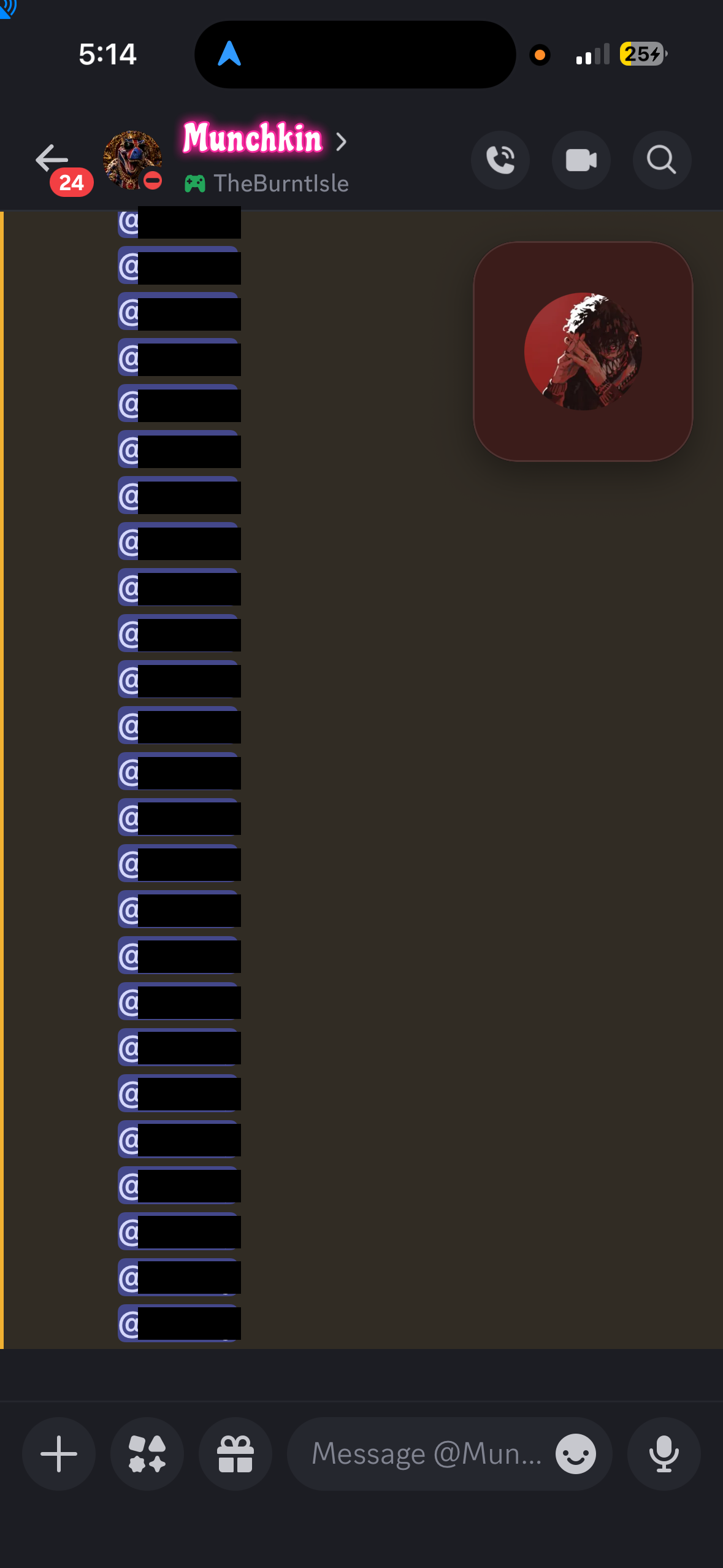
Dozens of mentions in a row. Each one is a separate push notification on their phone, and the effect is not a message that is hard to ignore but a device that becomes unusable until they give in. A few minutes later, he did it again.
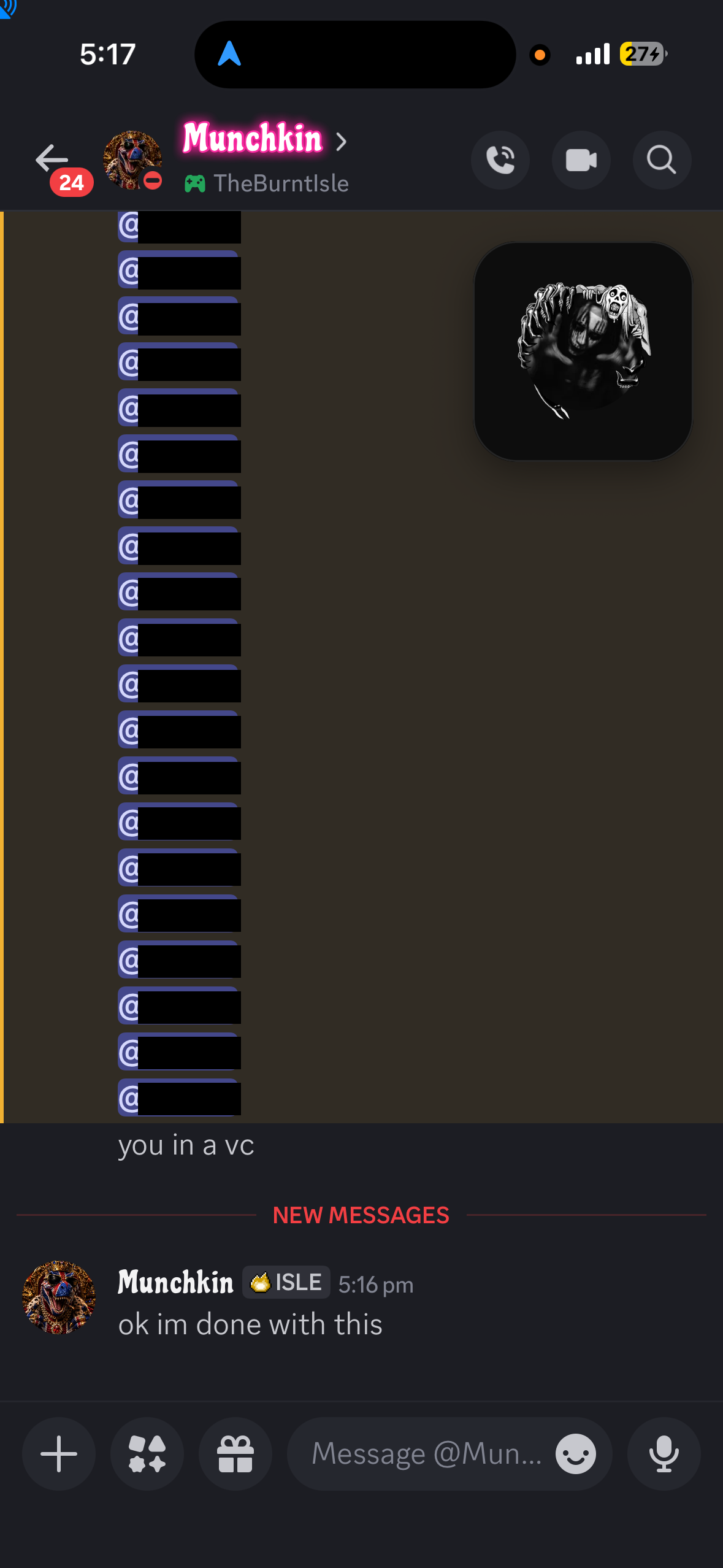
The notification badge visible in the corner of both screenshots shows the state of their inbox by that point.
This is not someone struggling to reach a colleague. There were other ways to get their attention and he had already used them. Sending a mention that many times, one after another, is not communication. Nothing is being said. The content of those messages is the notifications themselves, and their only function is to make the phone unbearable until its owner gives him what he wants.
What he wanted was not an answer to a question. There was no question. He wanted proof that he could still make them respond.
That is the part worth understanding, because it explains the rest of his behaviour on this page. A person not replying to a message is, in almost every case, a person who is busy. They had already told him they work. The reasonable readings were all available to him and none of them were taken. Their silence was not treated as absence. It was treated as defiance, and defiance is something to be broken rather than waited out.
"ok im done with this"
The second screenshot ends with him announcing that he is done with this.
He had spent the preceding minutes sending dozens of unanswered pings to someone who had said nothing back. He was the only participant. They had not argued with him, insulted him, or refused him anything, because they had not spoken at all. And at the end of it he is the one who declares that he has had enough and walks away wounded.
That inversion runs through everything above. In the earlier exchange, they raise a moderation problem and he tells them they are trying to gather backing against him. Ordinary staff work becomes a plot with him at the centre. They apologise to a player for a delay and explain they were at work, and he calls them stupid for it. A colleague doing the job correctly becomes a personal failure aimed at him.
Each time, the same three steps. Something entirely normal happens. He reads it as an attack on himself. Then he responds to that imagined attack, and by the end of it he is the injured party in a situation he created alone.
It is also worth putting his conduct here next to his conduct in Part I, because the same man appears in both and behaves like two different people. Talking to a volunteer who has no power over him, he is contemptuous and relentless. Talking about the spoofer, before anyone could touch him for it, he is relaxed and joking, with an "ahaha" attached to the fact that his fake counter had jammed again. Then Dondi indicates that servers doing this will be pursued, and the same man panics.
The aggression and the fear track power precisely. Everyone below him gets one version of him, and the moment someone above him could impose a consequence, that version disappears. None of the confidence survived contact with anyone able to answer back.
They were volunteering their time for his server when all of this happened.
The day the admins quit
On 28 July 2026 two admins resigned. The exchange that followed runs across the whole day and is the clearest single record of how he ran that team.
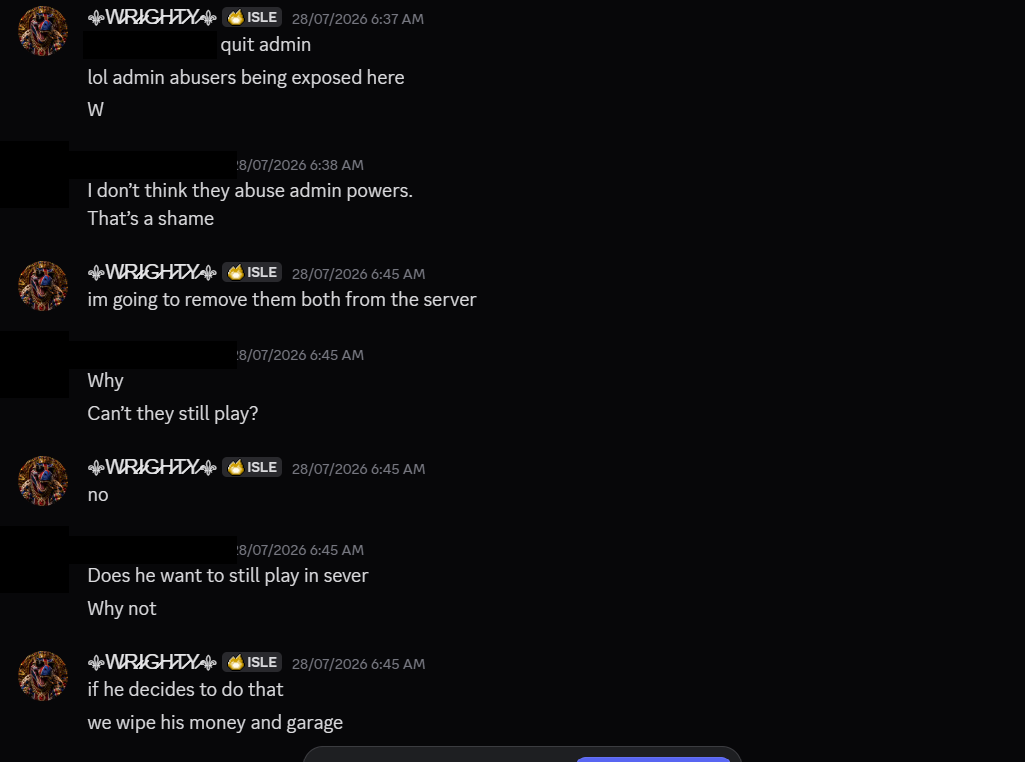
His opening reaction to two volunteers leaving is to call them admin abusers and post "W", as in a win. When the staff member tells him plainly that they do not believe the pair abused anything, he does not argue the point. He announces he will remove them both from the server entirely.
Asked why they cannot simply keep playing as normal players, the answer is no. Asked again, he sets out the consequence: if one of them chooses to keep playing, they wipe his money and his garage.
That is worth stating without decoration. Two people volunteered their time, chose to stop, and the response was to destroy the account progress they had built as ordinary players. Not for cheating, not for breaking a rule, but for resigning.
"Punished with death"
The same day, he extends it to anyone who might help them.
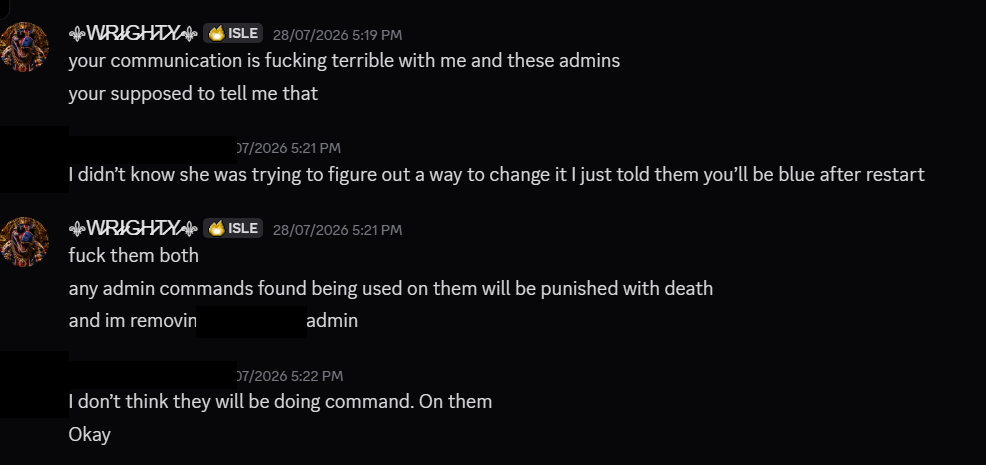
Any admin command found being used on those two would be punished with death, and a third staff member's admin access was removed for having, in his words, aided them in leaving. Helping a colleague depart is treated as an offence, and the remaining staff are told what happens if they show the departed any consideration.
The instruction that came earlier the same morning fits the same pattern: monitor the two resigning admins because their permissions were still active until the next restart. People who had just given notice were watched rather than thanked.
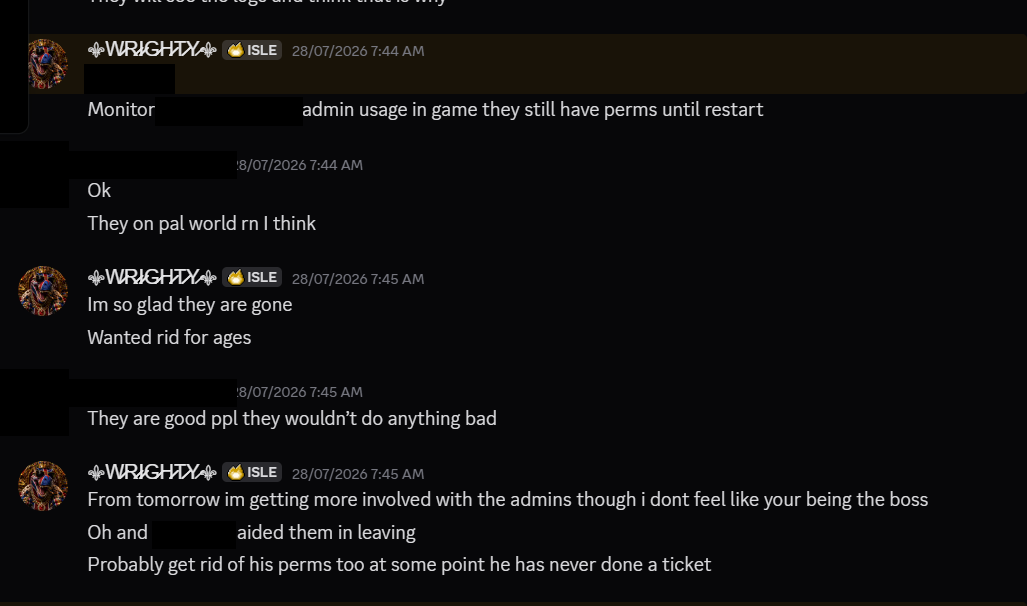
He also states his own position clearly here: he is glad they are gone and had wanted rid of them for a long time. Immediately after, when the staff member says they are good people, he moves to the next target and suggests removing a fourth person's permissions as well.
The reason the two gave for leaving is recorded as well, along with what he thought of it.
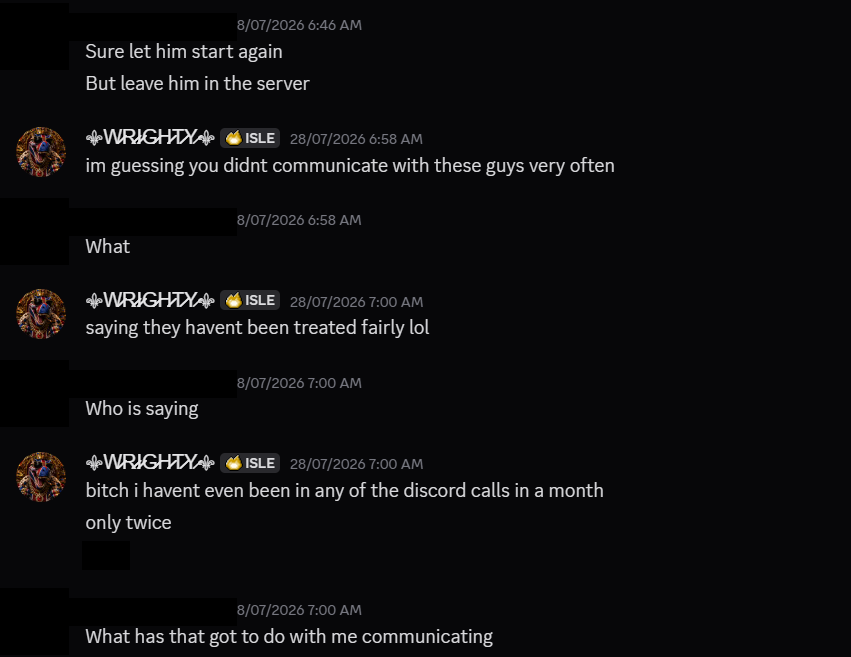
They had said they were not being treated fairly, which he repeats with "lol" attached. When asked who exactly is saying that, his response opens with "bitch" aimed at the senior staff member asking, followed by the admission that he had barely been in any of the team's calls for a month. Two admins resigned over unfair treatment, and the owner's own account of the situation is that he had not been present.
How he describes the people he depends on
Across these exchanges, the language he uses for the players and volunteers who make up his community does not vary much.
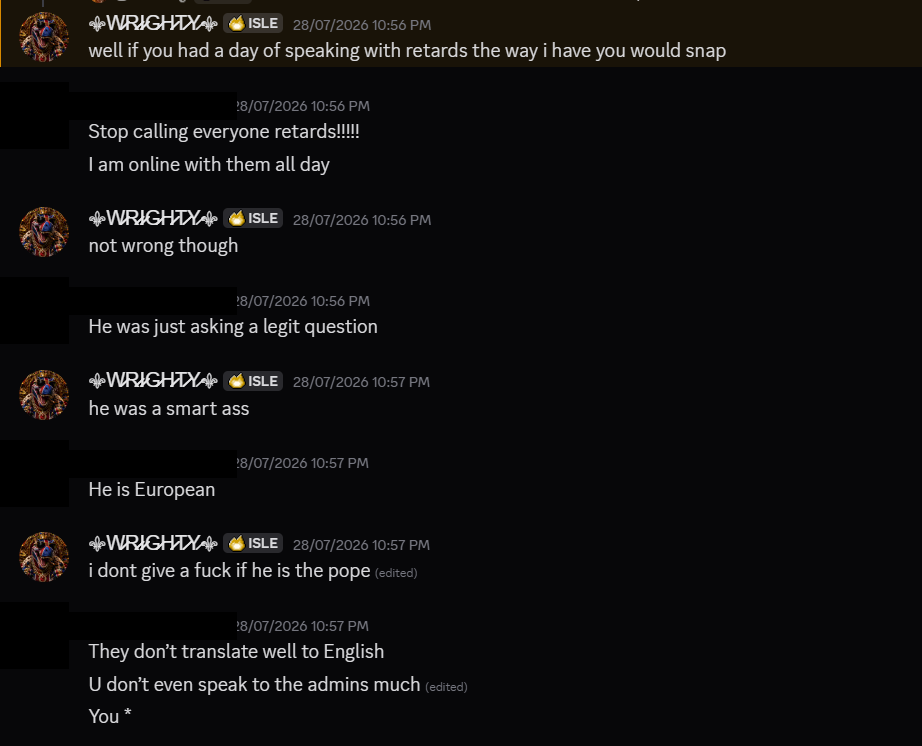
Told to stop calling everyone retards by the person who works with them daily, he answers that he is not wrong. When it is explained to him that the player he is describing had asked a legitimate question and does not speak English as a first language, the reply is that he does not care.
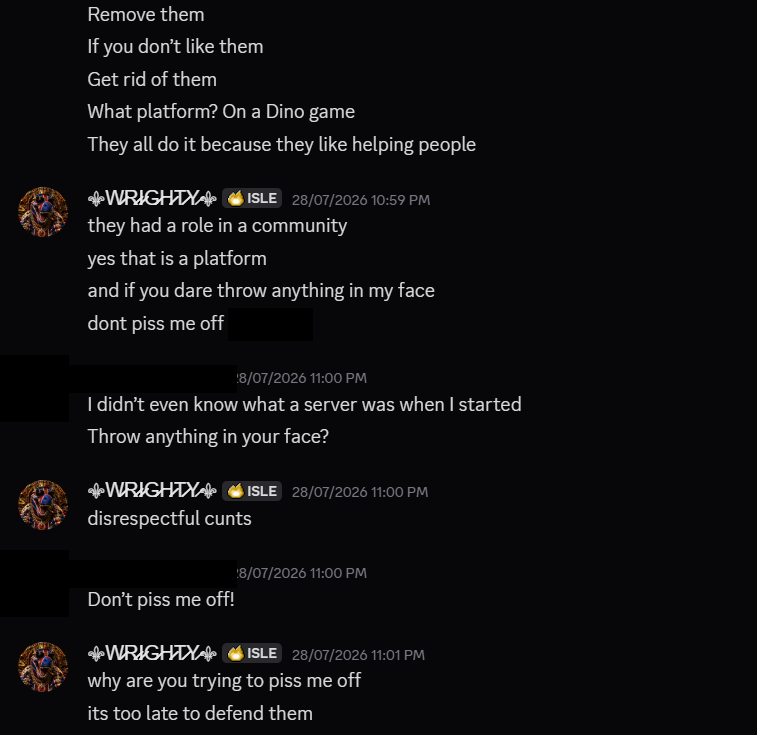
When it is pointed out to him that these people volunteer because they enjoy helping others, he calls them disrespectful cunts, then turns on the staff member for defending them. The words in that exchange are directed at unpaid staff who moderated his server and at players who paid to be there.
Being told he had stopped listening
The same night, the staff member tried to explain what was going wrong.
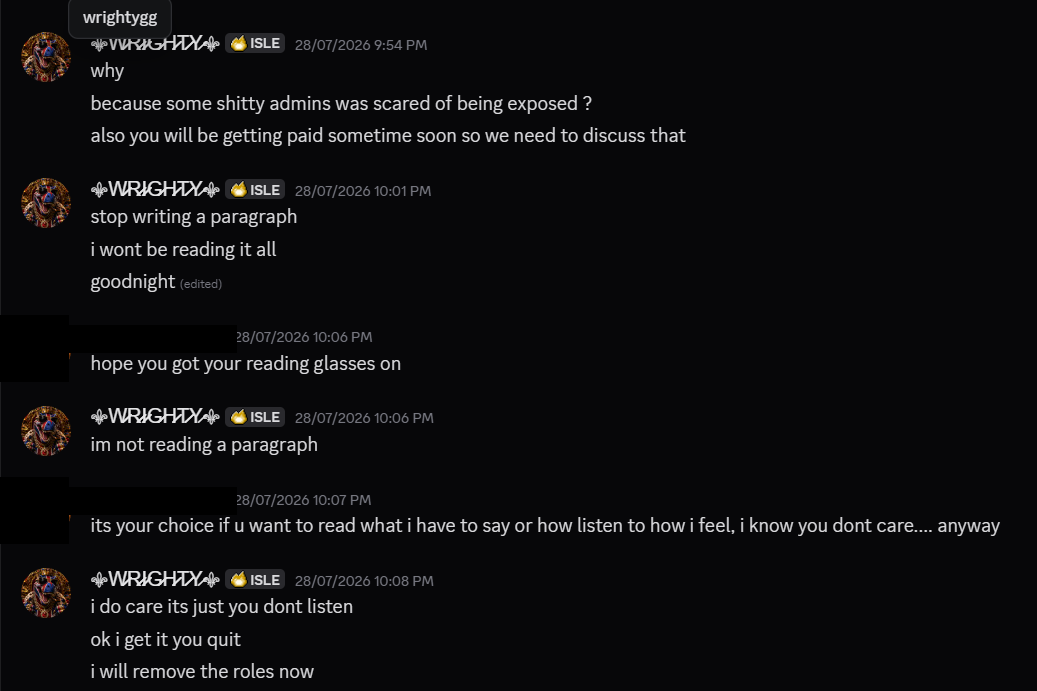
He tells them to stop writing a paragraph, that he will not be reading it, and says goodnight. When they persist, he repeats that he is not reading a paragraph. The answer names the problem exactly: it is his choice whether he wants to hear what they have to say, and they already know he does not care.
His reply is that he does care and they do not listen. Two messages after refusing to read what they wrote.
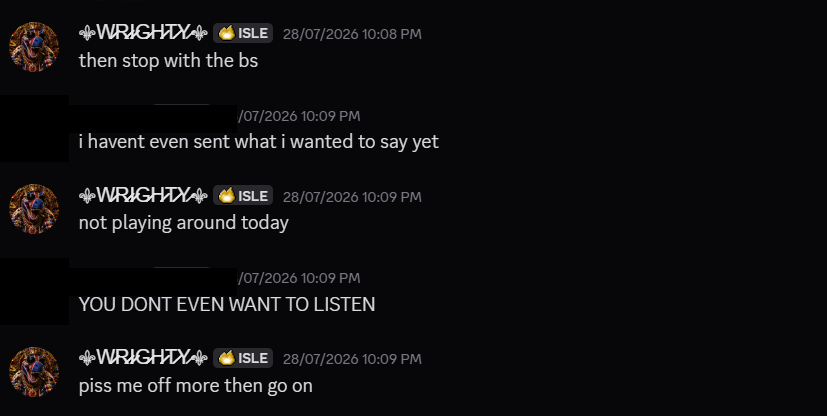
They had not finished saying what they wanted to say. What came back was that he was not playing around today, followed by an invitation to annoy him further.
Read alongside the earlier sections, the same shape appears again. Someone brings him a problem. He refuses to engage with the substance, reframes it as an attack on himself, and the conversation ends with the other person managing his temper instead of the issue being addressed.
What the whole record adds up to
Taken one at a time these are unpleasant messages. Read together, they describe a way of running a community that is worth setting out plainly, because every element of it appears in the screenshots above rather than in anyone's interpretation of them.
Leaving was treated as betrayal, and punished. Two volunteers resigned. Within minutes he moved to remove them from the server as players, and when asked why they could not simply keep playing, the answer was that their money and their garage would be wiped. Nothing they did earned that. Quitting did.
Helping the departed was punished too. Any admin command used on those two would be "punished with death", and a third person lost his admin access for having aided them in leaving. That is a rule aimed at the people who stayed: show the ones who left any kindness and the same thing happens to you. Loyalty between colleagues was treated as a threat, because the only loyalty that counted ran upward.
Departures were monitored rather than accepted. The instruction on the morning they resigned was to watch their remaining permissions until the restart. People who had already given notice were treated as suspects for the few hours they had left.
The complaint was answered with the word "bitch". They said they had not been treated fairly. He repeated it with "lol", swore at the person relaying it, and then confirmed he had barely attended the team's calls for a month. The grievance was neglect. The response proved it.
Everyone below him is described as defective. Retards, disrespectful cunts, dumb fuck, and an instruction to a resigning admin about what he can do. Applied to unpaid volunteers, to a player who asked a reasonable question in a second language, and to the person who spent every day holding the team together.
Objections became evidence of disloyalty. Raising a moderation problem with colleagues became a plot to gather backing against him. Defending the volunteers became throwing something in his face. Explaining a delay became not listening. There is no version of disagreement in these exchanges that he received as disagreement.
He was never present, and always aggrieved. By his own admission he had been in the team's calls twice in a month. He did not know why two of his admins were unhappy. He was told, repeatedly, and refused to read it. Then the collapse of the team was everybody else's failure to communicate.
And then there is the line that sits above all of it. Told that two of his admins had quit, his reaction was "lol admin abusers being exposed here". At the point he wrote that, the public log on his server was configured to hide self-directed commands, entries were being deleted, and the player count in the browser was a number he typed in himself. He was calling other people admin abusers while running all three.
That is the through line of this page. Not a temper, and not a bad week. A server where the rules applied downward only, where the people keeping it alive were disposable the moment they stopped being useful, and where the person setting the standard was breaking every one of them at the same time.
This page does not diagnose him, because none of the people who wrote it are qualified to and because it is not necessary. The conduct is documented. Readers can weigh it themselves.
Part III: Treatment of Players and Content Creators
Part II covered the people who worked for him behind the scenes. This section is about the people in front of it: the streamers who broadcast the server to an audience, and the players who kept it populated.
Content creators are the cheapest advertising a game server will ever get. Someone streams for two hours and every viewer sees the server name in the title bar. They are not paid for it, they choose the server, and they can choose a different one at any time. There is no version of running a server where their goodwill is worth nothing.
When the site broke during a stream
On 6 July 2026 a group of streamers left the server mid-broadcast because a part of the site they needed would not work for them.
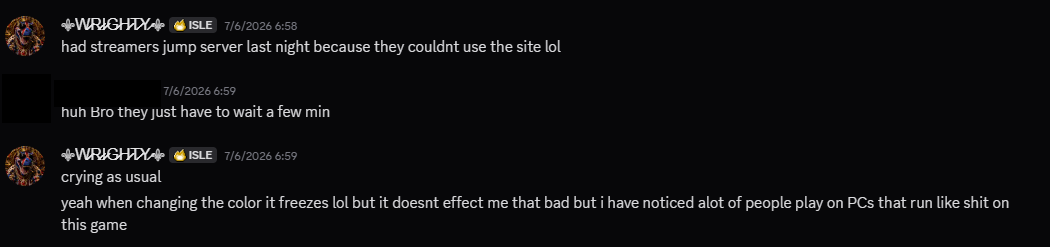
Look at how that is reported. Streamers abandoning his server on stream, in front of their viewers, is delivered as an amusing anecdote with "lol" attached. When it is pointed out that the wait was only a few minutes, his answer is that they were "crying as usual".
Then comes the part that undoes his own complaint. He confirms the problem is real. Changing the colour freezes the interface. He knows it, and he says so in the same breath. What follows is the reason it was never treated as urgent: it does not affect him badly. The fault is then handed to the users, who in his telling are playing on machines that run the game poorly.
That sequence is a pattern rather than a one-off. A known defect exists. It does not inconvenience him personally. The people it does inconvenience are mocked for raising it, and the cause is assigned to them. The problem itself is never the thing that needs fixing.
The people being described that way were promoting his server for free, and they were doing it live in front of an audience when it broke.
The other half of how streamers were handled
Several former team members have stated that streamers were repeatedly shielded from punishment on that server. Where an ordinary player would have been warned, punished or removed for breaking a rule, a streamer was not, and according to those accounts they were never penalised at all.
Those are statements from people who worked there rather than something a screenshot proves, and this page marks them as such.
Set against the exchange above, the two things are not a contradiction. They fit together. Streamers were worth protecting because they brought an audience, so the rules were quietly suspended for them. That protection was never respect, as the message about them shows plainly the moment they became an inconvenience instead of an asset.
For everyone else, it means the rules on that server were not the same for everyone. A player reported for something a streamer had done in the same session could expect a different outcome, and the moderation record they were shown gave no sign of it.
Bans for anyone building something of their own
Beyond what the screenshots show, there is a pattern in who ends up banned. According to statements from former team members, people who started planning or running servers of their own were removed, as were people found sharing other servers with players here.
That rests on those accounts rather than on a document, and this page flags it as such. What supports it is that the one case with a full record attached fits it exactly. The next section but one covers a paying supporter and content creator who was banned for sending invite links to other servers in private messages, which no published rule prohibited because no rules were published at all.
Taken together with the streamers, the through line is not hard to see. The server did not need to be better than the alternatives if players never found out the alternatives existed.
Part IV: Examination of the Public Admin Logs
The server ran a public transparency log. The idea behind that feature is straightforward and it is a good one: players can see what the staff are doing with their powers, so that an admin who heals his friends or slays someone he lost an argument with can be held to it. Trust in a server rests on that visibility. It is the difference between a moderation team and a group of people with unchecked control over other players' progress.
That log was configured to hide the abuse.
How the setting works
Every admin command has its own visibility setting in the panel, with three positions. Off, meaning it is never written to the public log. Always, meaning it is recorded no matter who it was used on. And a third option in the middle: only on other players.
That middle setting is the one that matters. With it selected, the command is logged when an admin uses it on somebody else, and silently dropped when he uses it on himself.
Consider what that produces. An admin heals a random player who got mauled at a river, and the log shows a helpful staff member doing his job. The same admin heals himself mid fight, gives himself full growth, teleports himself to the target of a hunt, or slays himself to escape a losing situation, and the log shows nothing at all. Not a redacted entry. Not a private note. Nothing. The record reads as though those actions never happened.
The public log did not stop being trustworthy. It became a highlight reel, showing only the actions that made the staff look good while filtering out every action taken for personal gain.
The configuration
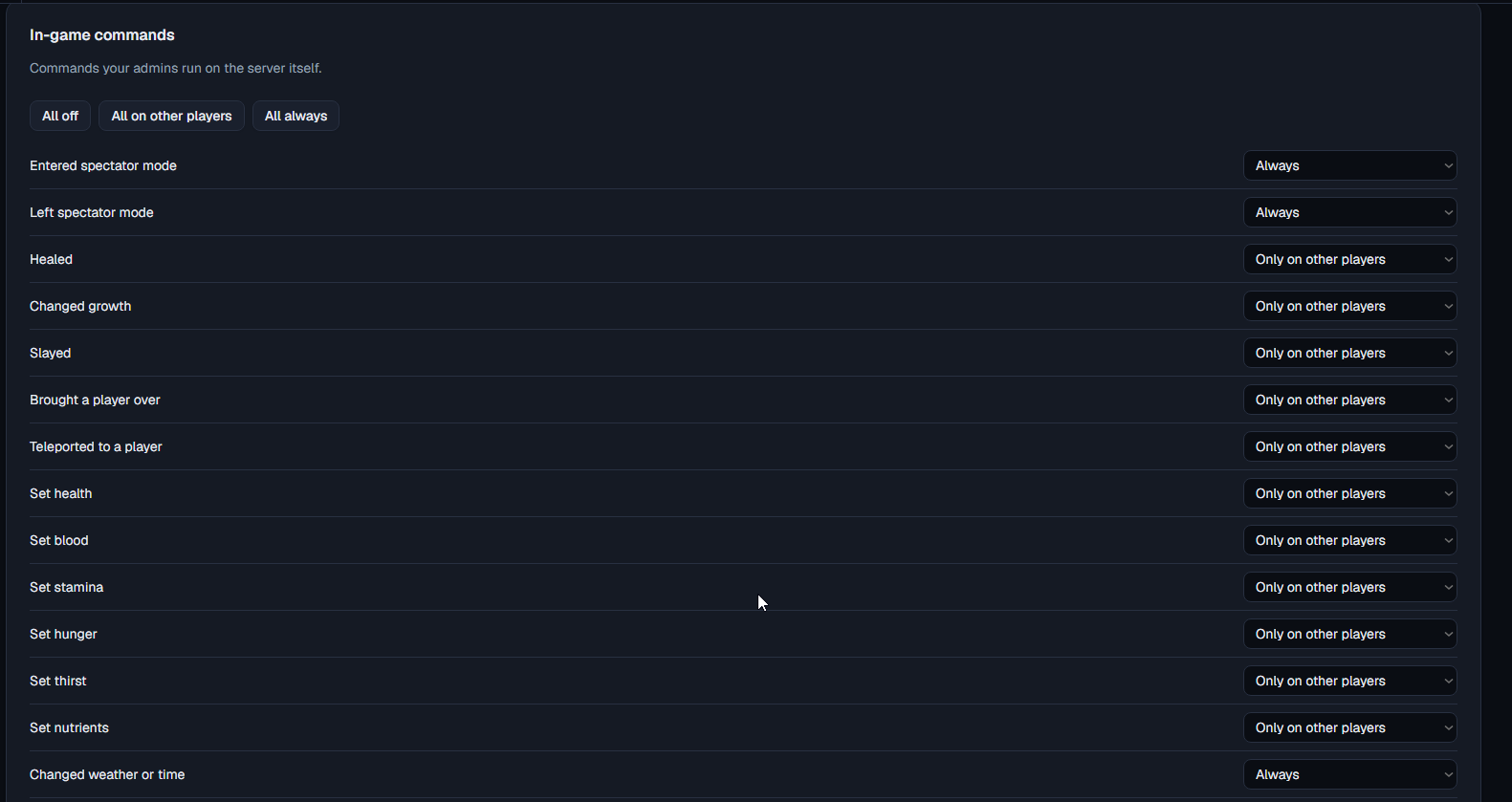
This is the server's own settings page. Read the right-hand column.
Healed, changed growth, slayed, brought a player over, teleported to a player, set health, set blood, set stamina, set hunger, set thirst, set nutrients. Every one of them is set to "only on other players". Those are precisely the commands that give an admin an advantage when used on himself: survival, size, position, and the resource meters that force everyone else to stop and eat, drink, and rest.
Now read the entries that were left on "always". Entered spectator mode, left spectator mode, changed weather or time. Nobody gains anything by spectating or by making it rain. Those are the harmless ones, and they are the ones the public was allowed to see.
The pattern is not accidental and it is not a default. Somebody went through that list one row at a time and made a decision about each command. Everything that could be used to cheat was hidden on self-use. Everything that proved the staff were present and active was left visible. The result is a log that publishes evidence of good behaviour and suppresses evidence of the opposite.
What was hidden
The exports on this site show what that setting was concealing.
Across the database, admins ran over 1,200 panel commands and around 250 in-game commands on themselves. None of that was visible to the players on the server.
The categories line up with the settings page exactly. Nearly 150 self-heals. Dozens of self-growth changes. Self-slays, self-set hunger, self-set nutrients, self-set stamina, self-set blood, self-teleports. Every category the panel was configured to hide on self-use has self-use sitting in the database behind it. On the panel side the largest single category is scale, used more than 800 times on themselves, alongside growth, gore, prime, stats, skins and mutations.
That is the point of publishing the raw exports here. The transparency logs on this site are the unfiltered version, taken from the database rather than from the public feed, with both what admins did to other players and what they did to themselves. They are searchable by name and by SteamID, so any player who spent time on that server can look up what was actually done and compare it against what they were shown at the time.
Deleting what the filter still let through
Hiding self-directed commands was only the first layer. The second was removing entries that had already been written.
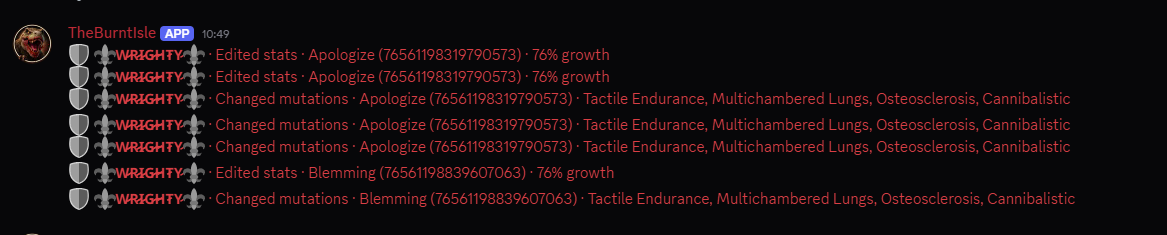
That is the public feed doing exactly what it is supposed to do. It shows WRIGHTY editing another player's stats to 76% growth and handing out mutation sets, then doing the same for a second player. These are commands used on other people, which is the one category the settings page left switched on, so they appeared where everybody could read them.
Entries like these did not stay up. According to former staff, logs were deleted when they showed something he did not want visible, including actions taken on other players rather than on himself. He says as much himself while discussing the problem with senior staff.
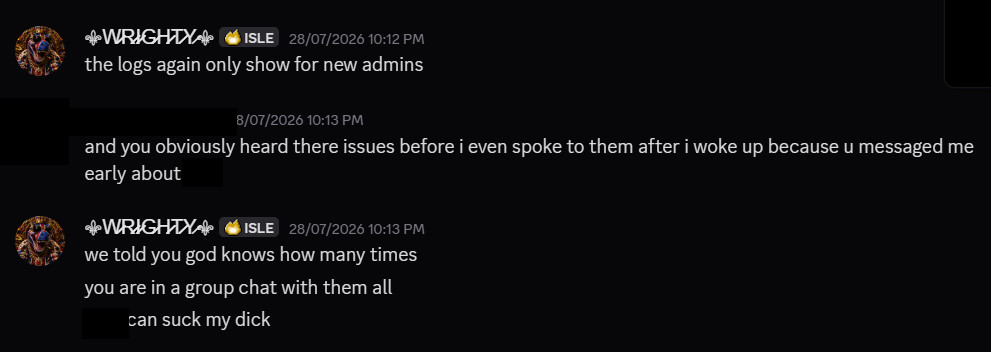
"The logs again only show for new admins." Whatever the state of the feed at that moment, the person in charge of it is discussing who can and cannot see the record, at the same time as staff were leaving over exactly this subject.
Put the three layers together and the picture is complete. Self-use was filtered out by configuration. What survived the filter could be deleted afterwards. And visibility of the log itself was something he adjusted. A record with all three properties is not a transparency feature. It is a publishing tool, and the person operating it decides what the public gets to know about his own conduct.
That is the reason the raw database exports on this site matter. They were not taken from the public feed, which is the version he controlled. They come from the database underneath it, and nothing in them was filtered, hidden or removed.
Whose idea it was
This behaviour was not a bug and it was not an oversight in somebody's code.
It was WRIGHTY's idea. He specified it, and he instructed Yannik to build it that way. Yannik built it. It was his job, he was paid for the work, and he did not refuse it. That is stated here as plainly as the rest, because a page that documents someone hiding evidence cannot then hide the fact that the person writing it is the one who wrote the feature.
There was no technical reason for the middle setting to exist. A log is either complete or it is not. The only thing that option adds is the ability to keep self-directed commands out of public view while still appearing to publish everything, and that is what it was asked for and what it was used for.
Part V: Paid Memberships, Bans, and Consumer Rights
The server sells monthly memberships through Patreon. Supporters pay every month for benefits on the server, and the top tier costs €87 a month at the time of writing. The page tells prospective supporters that every pledge keeps the world online and paid for.
That figure is worth holding onto while reading the rest of this section. At the top tier a supporter pays over a thousand euros a year for access to a private game server, on a recurring subscription, with nothing written down anywhere setting out what they get, what would cause them to lose it, or what happens to their money if it is taken away.
What that page does not contain, anywhere, is terms of service. No rules, no conditions of membership, no refund policy, no statement of what would cause someone to lose the access they are paying for. The same is true of the server itself. Money is taken monthly for continued access, and nothing written down says what a customer has to do to keep it.
What happened to ZaayaN
ZaayaN was a paying member. He was banned, and he asked why.
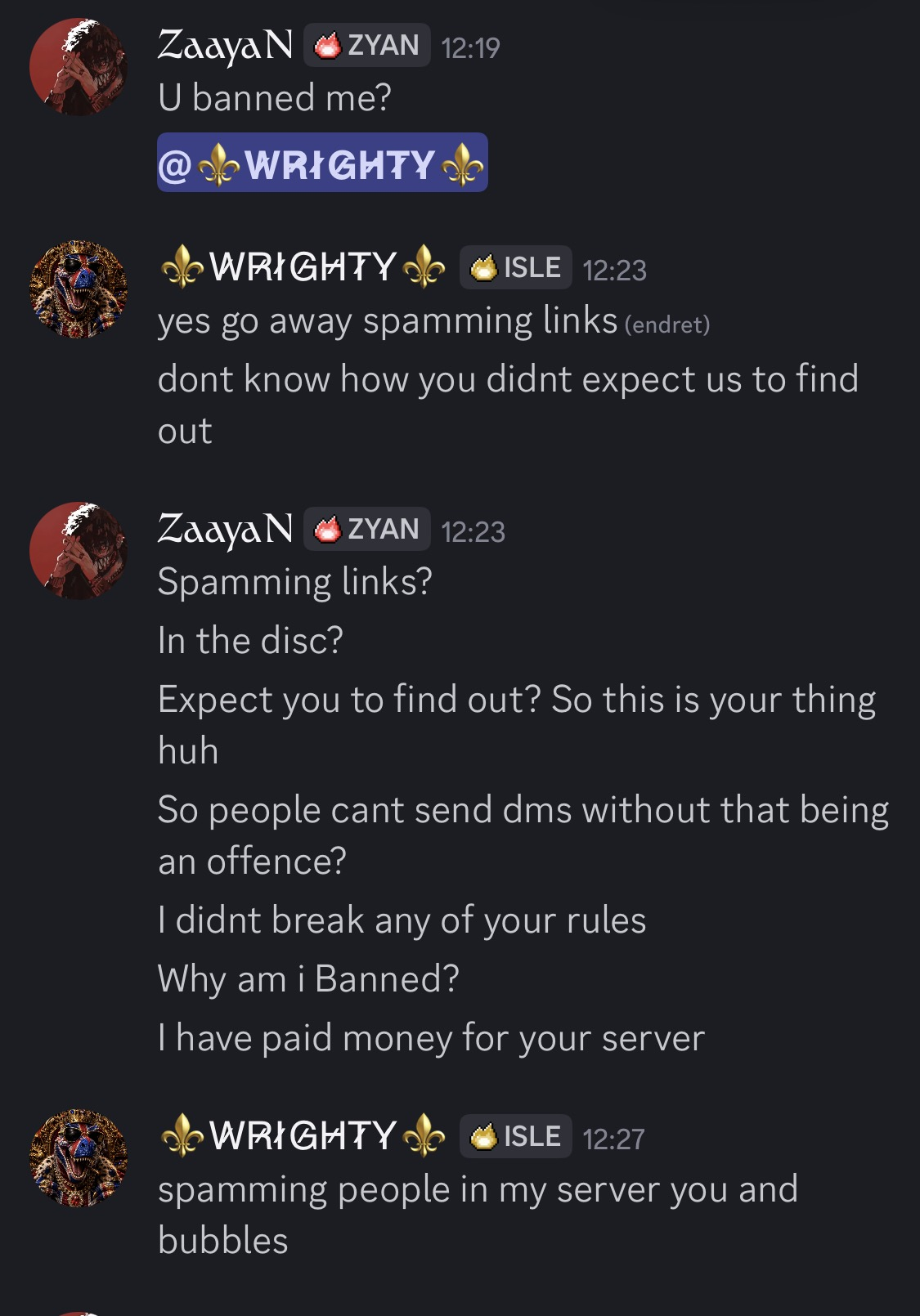
The stated reason was sending links. Not in the server's public channels, but in private messages to individual people. His reply is the important part of that exchange, and he makes three points that go unanswered.
He asks whether sending a private message is now an offence. He says outright that he broke none of their rules. And he points out that he had paid money for the server.
WRIGHTY does not dispute any of it. He does not point to a rule, because there is no rule to point to. He restates the accusation, adds a second name to it, and the conversation is over. A customer paying monthly lost what he was paying for, on the spot, for conduct that appeared in no published rule and took place in private conversations outside the server.
Cancelling the renewal cost him the month he had paid for
A second supporter came forward after this page was being put together. His account is short and the paperwork backs it up.
He paid on 1 August for that month of membership.
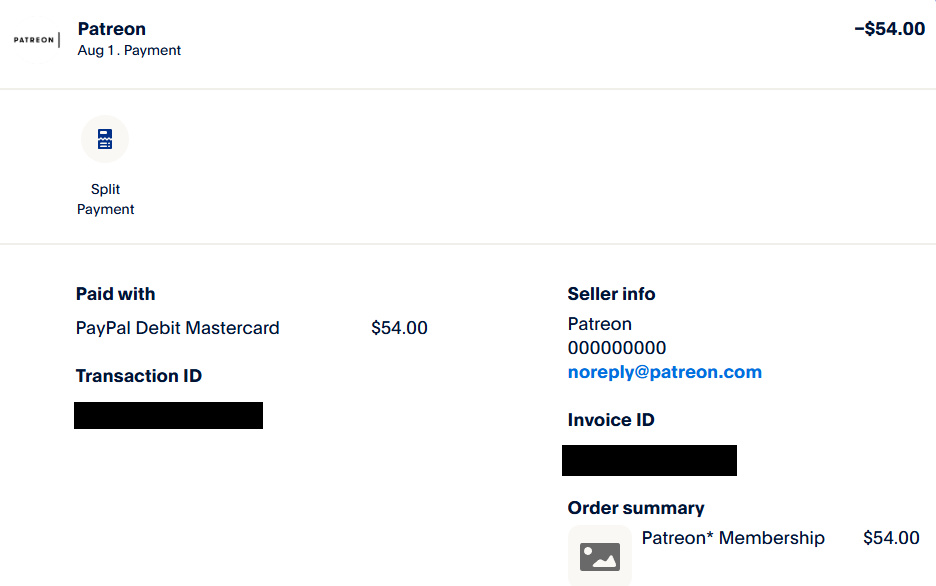
The receipt shows the date, the amount and that it was a Patreon membership charge. The transaction and invoice references are blacked out here because they identify his payment account and serve no purpose on a public page.
He had been a member before this and the benefits had worked as advertised during the earlier month, so there is no argument that he misunderstood what he was buying. What he did next was cancel the automatic renewal, which is the ordinary way of telling a subscription service not to charge you again next month. It does not ask for the current month back and it does not end the month already paid for.
Four days later his access was gone.
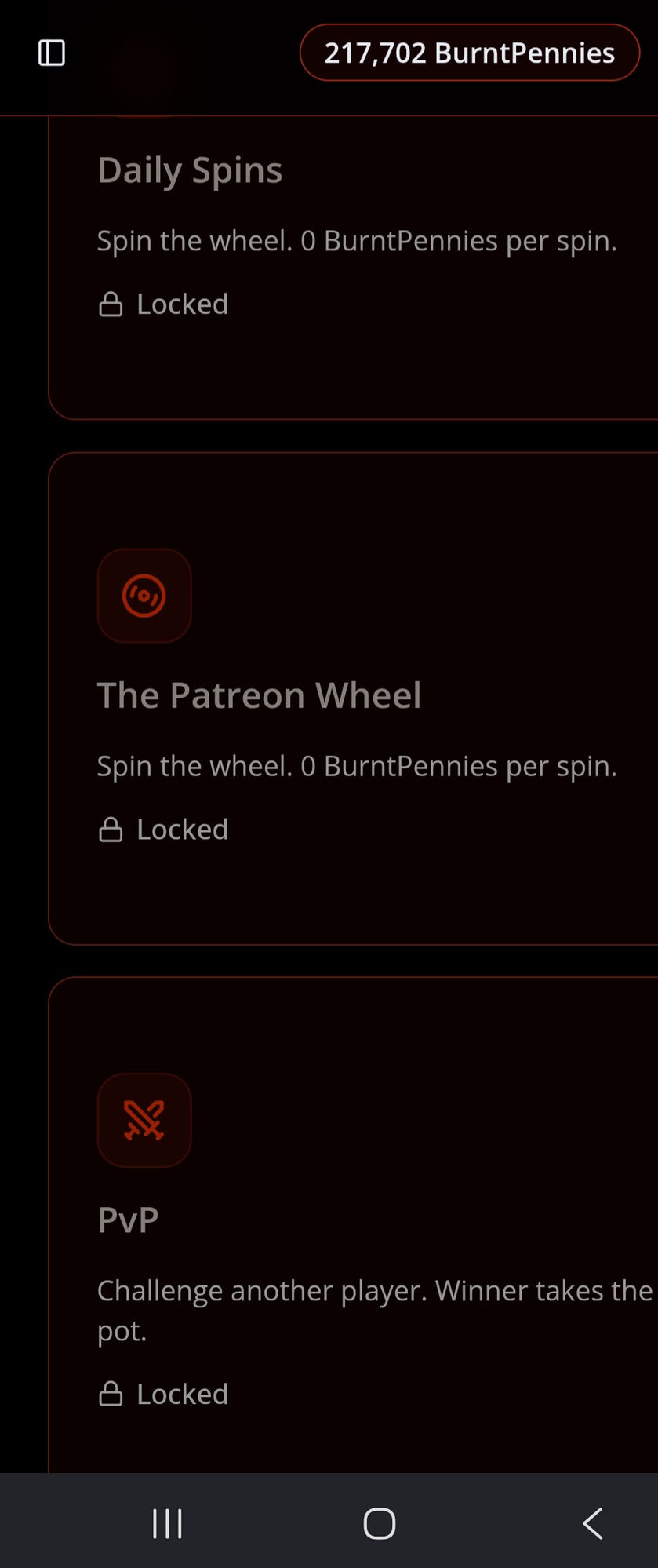
This is what the paid areas looked like afterwards. The daily spins, the wheel and the player versus player feature all sit behind a padlock, on an account that had paid for the month four days earlier and still shows its balance.
Cancelling a renewal is not a breach of anything. It is the mechanism the platform provides, and using it is what every consumer protection regime in the UK and the EU exists to make safe. Here it was treated as grounds for removal, and roughly twenty six days of paid access disappeared with it.
That fits the law described below in the most direct way possible. The access was cut off part way through a period that had been paid for in full, which is precisely the situation section 44 covers when it says the price reduction may be the full amount paid. It also demonstrates the point the rest of this section makes about missing terms. If the server had published a rule saying that cancelling the renewal ends access immediately, a customer could have read it and decided not to pay. There was no such rule, because there were no rules.
Why the missing terms of service are the problem
The instinct behind running a server with no written rules is that it leaves the owner free to do whatever he wants. In UK consumer law it does close to the opposite. What follows is a description of the law as published by Parliament and the Competition and Markets Authority. It is not legal advice, and where the position is arguable this page says so.
He is very likely a trader. The Consumer Rights Act 2015 applies to a "trader", meaning someone acting for purposes relating to their business. The CMA's guidance points to whether the activity is regular, organised and carried on for profit. A recurring monthly subscription with priced tiers and advertised benefits, sold to multiple people, sits on the trader side of that line. A plain donation button would not. This is the one point everything else depends on, and it is the point he would contest.
Server access counts as digital content. The explanatory notes to the Act give online games served from a remote machine as the example of this. That matters because section 39(5) says the contract is treated as including a term that the facility must remain available to the consumer for a reasonable time, unless the contract specifies a period. His contract specifies nothing, so the implied term is what applies.
The absence of terms does not remove obligations, it removes his defences. Sections 34 to 37 imply quality, description and fitness terms into the contract whether or not anyone wrote them. The description on the Patreon page becomes part of the deal. What he does not get, having written nothing, is any express right to ban, suspend or refuse a refund. To have one he would have to persuade a court to imply it, and the test from the Supreme Court in Marks & Spencer v BNP Paribas is strict necessity or obviousness. The burden is on him.
A ban clause of the kind he would need is one the CMA lists as unlikely to be fair. Its guidance gives, as examples of terms unlikely to survive the fairness test, one reserving the right to withdraw or suspend membership when in the trader's sole opinion the member is behaving inappropriately, and one allowing membership to be made void with no reimbursement of the subscription. The Act's grey list covers cancelling for vaguely defined reasons, keeping money paid for something not supplied, and binding a consumer to terms they had no real chance to see beforehand. The last of those describes this situation exactly, because there was nothing to see.
Refusing refunds without published terms is the weakest position of all. Under the 2013 distance selling regulations, a consumer normally has 14 days to cancel. Regulation 31 extends that to twelve months and 14 days where the trader never provided the required cancellation information, which he did not. Regulation 37 removes the right to cancel digital content only where the consumer expressly consented and acknowledged losing it before delivery began, which without terms almost certainly never happened. Separately, section 44 gives a consumer the right to a price reduction where the content cannot be repaired or replaced, and states that the reduction may be the full amount of the price. Cutting off access mid-month is precisely that situation.
A blanket "no refunds" stance fails twice over here. It was never part of any agreement because no agreement was published, so there is nothing to enforce. And announced afterwards, in a chat message, it is a consumer notice under section 61 and can be assessed for fairness like any term. The CMA's position is that sums described as non-refundable should generally still be refunded where the consumer received no benefit.
What Patreon does and does not do
Patreon's own terms put this risk on the customer. Its default position is not to give refunds, including where access is lost because, in its own wording, the creator blocks you. Its help pages state that a creator failing to deliver expected benefits is discouraged but does not breach Patreon's terms. Refund requests are decided by the creator in the first instance, inside a 60 day window.
There is a contradiction worth knowing about. Patreon's refund policy lists a fan being blocked before receiving rewards as a case that qualifies for a refund, while also excluding benefits delivered off the Patreon platform, which in-game perks on a private server are. Both statements cannot govern this situation at once.
The practical effect is that the person best placed to decline the refund is the same person who took the access away.
What someone in that position can actually do
For anyone reading this who paid and was cut off, the realistic routes are these, and none of them run through the server owner.
Request the refund inside Patreon first, within 60 days of the payment, and keep the record of it being declined. If the payment was by card, ask the card issuer about a chargeback, which is a card scheme process rather than a legal right and has its own deadline that varies by scheme. A refusal there can be escalated to the Financial Ombudsman Service at no cost. Section 75 of the Consumer Credit Act generally will not help, because it excludes items under £100 and because the purchase went through a platform rather than directly to the trader.
Beyond that, a claim in the small claims track is the only route that produces an individual remedy. It runs online, the issue fee starts at £35, and the limitation period is six years. Trading Standards will take a report but will not recover anyone's money, and the CMA does not act on individual complaints at all. Reports still have value in aggregate, through the Citizens Advice consumer service, because patterns across multiple complaints are what enforcement bodies act on.
The point of this section
The argument is not that a server owner must keep every customer forever. Owners can and should remove people who wreck a community, and a properly written set of rules and a refund policy would have given him the standing to do exactly that.
He wrote none. He took recurring monthly payments with no stated conditions, banned a paying customer for conduct that no rule covered and that took place in private messages, and kept the money. Every protection he could have built for himself, he skipped, and the effect of skipping it is that the customer's position is stronger rather than weaker.
Contact
If you have information, screenshots or logs that belong on this page, use the form below. It reaches the people who put this together and nothing else. You do not have to give a name or any way of contacting you, and nothing you send is published unless you agree to it.